Wednesday, August 23, 2006

Time to profile

http://www.danielpipes.org/article/3890

Time to Profile Airline Passengers?
by Daniel PipesNew York SunAugust 22, 2006
[NY Sun title: "Calls for Racial Profiling Increase After London Plot"]
The debate over profiling airline passengers revived after the thwarted Islamist plot to bomb 10 airplanes in London on Aug. 10. The sad fact is, through inertia, denial, cowardice, and political correctness, Western airport security services — with the notable exception of Israel's — search primarily for the
implements of terrorism, while largely ignoring passengers.
Although there has been some progress since the attacks of September 11, 2001, most involves the scrutiny of all travelers' actions. For example, in 2003, the Transportation Security Administration, charged with protecting American airplanes, launched a passenger profiling system known as
Screening of Passengers by Observation Techniques, or SPOT, now operating in twelve U.S. airports.
Adopting techniques used by the U.S. Customs Service and by Israeli airport security, SPOT is "the antidote to racial profiling,"
TSA spokeswoman Ann Davis, said. It discerns, she said, "extremely high levels of stress, fear and deception" through "behavioral pattern recognition." SPOT agents observe passengers moving about the airport, with TSA agents looking for such physical symptoms as sweating, rigid posture, and clenched fists. A screener then engages "selectees" in conversation and asks unexpected questions, looking at body language for signs of unnatural responses. Most selectees are immediately released, but about one-fifth are interviewed by the police.
After the London plot, the British authorities instituted a
crash-course in SPOT, learning directly from their American counterparts.
Building on this approach, an Israeli machine, called
Cogito, uses algorithms, artificial-intelligence software, and polygraph principles to discern passengers with "hostile intent." In trial runs with control groups, the machine incorrectly fingered 8% of innocent travelers as potential threats and let 15% of the role-acting terrorists slip through.
While methods that target the whole population have general value — SPOT did discover passengers with forged visas, fake IDs, stolen airline tickets, and various forms of contraband — its utility for counterterrorism is dubious. Terrorists trained to answer questions convincingly, avoid sweating, and control stress should easily be able to evade the system.
The airport disruptions following the thwarted London plot prompted much discussion about the need to focus on the source of Islamist terrorism and to profile Muslims. In the words of a
Wall Street Journal editorial, "a return to any kind of normalcy in travel is going to require that airport security do a better job of separating high-risk passengers from unlikely threats."
This argument is gaining momentum. A recent
poll found that 55% of Britons support passenger profiling that takes into account "background or appearance," with only 29% against. Lord Stevens, the former chief of Scotland Yard, has endorsed focusing on young Muslim men. The Guardian reports that "some EU countries, particularly France and the Netherlands, want to … introduce explicit checks on Muslim travelers."
One politician in
Wisconsin and two in New York State came out in favor of similar profiling. A Fox News anchor, Bill O'Reilly, has suggested that Muslim passengers ages 16 to 45 "all should be spoken with." Mike Gallagher, one of the most popular American radio talk-show hosts, has said he wants "a Muslim-only [passenger] line" at airports. In a column for the Evening Bulletin, Robert Sandler proposed putting "Muslims on one plane and put the rest of us on a different one."
The
British Department for Transport reportedly is seeking to introduce passenger profiling that includes taking religious background into account. News from British airports indicates that this has already begun – sometimes even by fellow passengers.
Three conclusions emerge from this discussion. First, because Islamist terrorists are all Muslims, there does need to be a focus on Muslims. Second, such notions as "Muslim-only lines" at airports are
infeasible; rather, intelligence must drive efforts to root out Muslims with an Islamist agenda.
Third, the chances of Muslim-focused profiling being widely implemented remain negligible. As the same Wall Street Journal editorial notes, "the fact that we may have come within a whisker of losing 3,000 lives over the Atlantic still isn't preventing political correctness from getting in the way of smarter security."
Noting the limited impact that losing 3,000 lives had in 2001 and building on my "
education by murder" hypothesis — that people wake up to the problem of radical Islam only when blood is flowing in the streets — I predict that effective profiling will only come into effect when many more Western lives, say 100,000, have been lost.

I keep saying this, I do not understand why this is not approached like any other crime problem, figure out the characteristics most likely to be commonly held by the most likely suspects, and search for people who fit that profile. And the number one factor that these terrorists have in common is their religion, they are Muslim. Race, gender, those are only slightly useful profiling tools as terrorists seek to find female murderers or murderers of different races to try to escape detection. There may be Buddhist, Christian, Hindu, Bahai, and Shinto terrorists, but if there are, they seem to be ineffective. The danger seems to be overwhelmingly from Muslim terrorists, and for that reason it would be wise for that factor to be the primary characteristic considered when travelers are scrutinized. Since profiling on the basis of religion is 'politically incorrect" there is little likelihood it will be done. That is, until, as Mr. Pipes has said, thousands more Westerners are dead and more blood is flowing in the streets.

If airport screening was applied to everyday life.....

Sunday, August 20, 2006

The Face of Stupid

http://news.scotsman.com/scotland.cfm?id=1216282006


Ever Wonder What Stupid Looks Like? Here it is Is.


Robert McGuire still carries the marks of the adder bite on his right armPicture: Colin Templeton

A HILLWALKER who nearly died after he was bitten by an adder revealed that he picked up two of the snakes so his brother could take a photo of them with a mobile phone.
Robert McGuire was bitten last Saturday while holidaying on the Isle of Arran.
The 44-year-old suffered a severe allergic reaction to the bites and had to be taken to hospital by air ambulance from a remote area of Goat Fell. He spent six days receiving treatment.
Speaking for the first time since he was released from hospital, Mr McGuire described the moment he was bitten.
"I was out for a walk with my brother Steve and his kids. We were going off to have a picnic at a local beauty spot.
"The next minute, one of the kids ran up and said there was a snake in the grass. I just thought it was a grass snake.
"I just bent down to pick it up so my brother could take a photo with his mobile phone. Suddenly a massive black snake just appeared, so I picked that up too. It was then that the second one just sank his fangs right into my hand and then the other one did the same to my other hand."
Mr McGuire told The Scotsman that he had not been particularly concerned about picking up the reptiles as he did not believe there were venomous snakes in Scotland.
Throwing the adders away, the combined effect of their venom began to take effect almost immediately as Mr McGuire's body started to go into anaphylactic shock, a violent allergic reaction which can result in death.
"There was blood just gushing out. I screamed and my brother ran off to get help," he said. "Everyone else was screaming and panicking too.
"Within a few minutes my face started to tingle and tongue started to swell up. Twenty minutes later, I couldn't talk right and couldn't breathe, then my face started to blow up and my hands started swelling. I realised I'd been poisoned."
As the venom coursed through his body, Mr McGuire described how it 'went into revolt', and he began to vomit repeatedly and sweat copiously: "I was sick everywhere, everything in my body just left me. It was terrible.
"My legs went, I couldn't walk, they were just like rubber. I was terrified, I thought that was it, I'd never see my family again."
Adders are Britain's only venomous snakes, but severe reactions to their bites are rare. Fewer than ten people are thought to have died from an adder bite in the UK during the past 50 years.
Mr McGuire said that his final recollections before passing out were of being injected repeatedly with hypodermic needles by the paramedics.
It was the following day before he regained consciousness in hospital, where he discovered that his whole body and head were swollen almost beyond recognition.
"I woke up in hospital, and I kept biting my tongue because it was that big. My lips looked like Mick Jagger's, they were so swollen.
"I felt dead weak and all bloated. I was like Hulk Hogan, my arms were really blown up.
"I couldn't talk and I kept wanting to touch my face because it was all swollen. I couldn't use my hands, they were useless."
"The doctor said I was lucky to be alive. He had told my family while I was being treated that they should expect the worst."
Horrified by his own appearance, Mr McGuire refused to let his family see him while he was in hospital.
He is now back at his home in Saltcoats, Ayrshire, where he lives with his wife Maureen, 37, and his six children: Kerry, 19, Chris, 17, Nicole, 11, Stephanie, ten, Robert, five, and two-year-old Greg.
This article: http://news.scotsman.com/scotland.cfm?id=1216282006
Last updated: 18-Aug-06 00:53 BST


I would say that this is the dumbest thing I have heard of in a while....I mean, this is cosmically 'uberstupid' . I don't care whether he knew, or if there are, poisonous snakes in Britain, snakes bite! Why on earth would you want to pick one up ? And for a silly picture? And the man's brother must also suffer from being in the shallow end of the gene pool since the article makes no mention of him trying to dissuade his stupid brother from doing the stunt. Fortunately the man survived, but obviously he could have died for his idiocy.

We can only hope that the children of these two idiots inherited their intelligence genes from their mothers.

Thursday, August 17, 2006

Let's Get Real.....


http://www.philly.com/mld/dailynews/news/opinion/15292574.htm
Posted on Thu, Aug. 17, 2006
Michael Smerconish
Skip the grannies: The case for airport profiling
FIVE YEARSremoved from 9/11, it's time to admit that profiling is not a dirty word.
Profiling is street smarts by any other name. It's the common-sensical recognition that while America is not threatened by an entire community, she is under siege by a certain element of an identifiable group, and law enforcement needs to target its resources accordingly.
The failure to profile is a dereliction of duty on the part of an administration that has otherwise been willing to incur the wrath of civil libertarians as it aggressively fights the war on terror.
Only last week, in the aftermath of the thwarted attack emanating from the U.K., did the president appear to take a step in the direction of profiling when at last, he acknowledged with specificity those who threaten our survival:
"This nation is at war with Islamic fascists who will use any means to destroy those of us who love freedom."
Hopefully now there will be a long overdue confrontation of the Emperor Has No Clothes charade whereby law enforcement is mandated to ignore the naked barbarism of radical Islam. The arrest of two dozen in connection with the latest, failed plan should change that. After all, they are the same-old, same-old. I refer to Messrs. Ali, Ali, Ali, Hussain, Hussain, Hussain, Islam, Kayani, Khan, Khan, Kha-tib, Patel, Rauf, Saddique, Sarwar, Savant, Tariq, Uddin and Zaman. To a person they are Muslim men.
Where some would highlight the slight differences among them - class, upbringing and whether they were raised Muslim or converted to Islam - I see the commonalities. Equally significant is who they are not.
They are not Americans. They are not urban blacks. They are not suburban whites. They are not Jews. They are not Hispanics. They are not members of the U.S. military, women, senior citizens or young kids. At a minimum, it is time to profile by exclusion.
Some are still standing in the way. Take Paul Stephenson, the Scotland Yard deputy commissioner, who, on the day the plot was made known, said:
"What I would want to say, and you would expect me to say about this, is this is not about communities. This is about criminals. This is about murderers, people who want to commit mass murder. This is not about anything to do with any particular community."
Wrong, Deputy Stephenson, I would not expect you to say that. And while this is not about a particular community, it most certainly is about people within a particular community.
More appropriate from London were the observations of Max Hastings in the Daily Mail. Hastings correctly noted, "In every other area of criminal activity, we accept that some people are more deserving than others of suspicion."
He pointed out that police do not question women when seeking a rapist, don't round up short West Indians when pursuing a 6-foot white burglar, and don't arrest an elderly widow for car theft when security cameras captured an Asian male.
For years I have been advocating that the United States use this kind of street smarts in the war against radical Islam. I did not begin with any particular knowledge of the subject. To the contrary, whatever understanding I've obtained sprang from a common occurrence in connection with a routine flight.
In March 2004, my family of six was heading to Florida for spring break. At a ticket counter in the Atlantic City airport, my 8-year-old son was singled out for "secondary" or random screening.
I knew it was absurd, but I didn't complain, figuring it was the small price we all have to pay post 9/11. Common sense told me it was a terrible waste of precious resources.
Soon after my son's screening, Dr. Condoleezza Rice testified in front of the 9/11 Commission. Commissioner John Lehman floored me when he asked Dr. Rice this:
"Were you aware that it was the policy, and I believe it remains the policy today, to fine airlines if they have more than two young Arab males in secondary questioning because that is discriminatory?"
I wondered what in the world he was talking about with his quota question. So I called Secretary Lehman and asked him. He told me that airline executives had said as much in testimony before the 9/11 Commission.
Lehman faulted political correctness and said "no one approves of racial profiling. That is not the issue, but the fact is that Norwegian women are not, and 85-year-old ladies with aluminum walkers are not, the source of the terrorist threat. And the fact is, our enemy is the violent Islamic extremism. And so the overwhelming number of people that one needs to worry about are young Arab males."
Lehman was dead-on. When I reported what Secretary Lehman told me in the Daily News, I incurred the wrath of the Department of Transportation. It said I was "wildly incorrect" in my reporting, where I had simply repeated the words of a 9/11 commissioner.
Then I had a chance encounter with Herb Kelleher, the legendary, ballsy founder of Southwest Airlines. He confirmed for me some of what Lehman had raised with Dr. Rice. So I kept digging. Later I learned the specific basis for Lehman's question regarding a quota system.
Edmond Soliday, former head of security for United Airlines, testified before the 9/11 Commission that "a visitor from the Justice Department who told me that if I had more than three people of the same ethnic origin in line for additional screening, our system would be shut down as discriminatory."
Soliday clarified his comments to investigative author Paul Sperry when he said that it was actually the assistant general counsel of the DOT. Soliday said the man "told me that if I had more than three people of the same ethnic origin in line for additional screening, our system would be shut down as discriminatory."
The DOT viewed any human profiling as discriminatory, even if it is based on statistical probability. As a result, Soliday said that United "loaded up the system with randoms to make it mathematically impossible to get three ethnics in line at the same time," including "soccer moms, Girl Scouts, and even little old ladies with walkers."
And there you have it, the origin of a PC policy that has hindered our ability to protect the skies on 9/11 and through today.
What I have learned since 9/11 about the absence of profiling in America's war on Islamic fascism has filled two books that I have authored. Since 9/11 we have seen the Madrid train bombings, the Bali nightclub bombings, London bombings on 7/7 and the most recent threat of a terror attack in the U.K.
My thesis remains unchanged. We are threatened by individuals who largely have race, gender, religion, ethnicity and appearance in common. To the extent we do not take that information into account as we seek to prevent a repeat of 9/11, we are still flying blind.
The president has finally acknowledged that some in a particular community seek to kill us. Hopefully his comments will set the tone for what is to come because his administration needs a mind-set change.
I say it's nice to philosophize about American peace, love and understanding, but right now we have a more important agenda. Like winning the war against radical Islam so that we are still around to engage in such dialogue when the dust settles.
Michael Smerconish is the author of "Flying Blind: How Political Correctness Continues to Compromise Airline Safety Post 9/11" and "Muzzled: From T-Ball to Terrorism - True Stories that Should Be Fiction."


I still can not believe that the government keeps giving the same level of scrutiny to all people. Almost a sort of comical "equal opportunity harassment" of everyone, except there is nothing comical about a failure to discover who are the terrorists among us. The absurdity of this even handed scrutiny procedure is highlighted as Mr. Smerconish suggests, by looking at the way police investigate potential criminals. Police determine a profile for whom they suspect may have committed a crime in question. That does not mean necessarily that there is no suspicion of any one else, but it does mean that based on their investigation, they suspect a person, or persons, who fit that profile is most likely to have been involved in the crime.

Why isn't this 'Criminal Justice 101' precept applied to finding terrorists? Not all Muslims are terrorists. Let me say that again, NOT ALL MUSLIMS ARE TERRORISTS! Unfortunately though, the overwhelming, vast majority of people associated with terrorism recently are Muslims. They SAY they are Muslims and are doing the terror acts for their religion, so I take them at their word on this. Therefore, shouldn't our finite resources focus on the most likely people to commit terrorism at this point, Muslim males between the ages of 17 and 40? It is foolhardy to disregard the most salient factor in common amongst most of the terrorists at this time, their religion, ( Islam) and pretend that all religious groups have an equal propensity for terrorism. Until we become less concerned about being "politically correct" in our views of religions and more concerned with discovering terrorists intent on slaughtering as many of us as they can, we are only playing at a deadly game. A game which we will, sooner or later, lose.

Tuesday, August 08, 2006

Fish Spears Man

http://www.theroyalgazette.com/apps/pbcs.dll/article?AID=/20060725/NEWS/107250168

News
Tuesday, August 8, 2006
Last modified: July 24. 2006 11:34PMSpeared fisherman recovering after surgery

By Sam Strangeways
An angler who narrowly escaped death after he was speared by a giant blue marlin and knocked out of his boat was still recovering in hospital last night – but his father said he expected him to return to sea as soon as he could.Ian Card was left with a fist-sized chest wound and underwent emergency surgery after the hooked creature struck him during an international sports fishing tournament on Saturday morning.His mother Elizabeth told The Royal Gazette yesterday that he was still very uncomfortable and was not accepting many visitors at the King Edward VII Memorial Hospital.His father Alan, who was captaining the boat while Ian acted as mate, said he could see no reason why the 32-year-old would stop fishing following the freak accident during the Sea Horse Anglers’ Club Bill Fish Tournament. “I would be most amazed if it had that effect,” said Mr. Card, 58, of Somerset.“It’s like falling off a horse; you get right back on. I don’t know how long it will take him to be well enough. He’s in pain and he’s a little bit groggy but other than that he seems to be okay.”The marlin – estimated to weigh 800 pounds and to measure 14 feet in length ( my emphasis) – was cut loose from angler Leslie Spanswick’s line after Ian was pulled to safety from the sea. “We have to go out there and retrieve the lure we lost,” joked Mr. Card, who operates his 40-foot charter fishing vessel Challenger with his son.Edwin Hawn, from Texas, the winner of the Sea Horse tournament – who bagged a 532-lb blue marlin and won the top prize of $78,000 on Sunday – has offered to donate some of his prize money to Ian to help him while he cannot work aboard Challenger. Meanwhile, another competitor picked up a special prize from contest organisers for rushing to help the Cards.Tournament producer Dan Jacobs said American physician Peter Watson, who was fishing on his boat, the Anita Jean, immediately offered his services when he heard the distress call on the radio.“He stopped fishing and ran in as fast as his boat would go to provide any assistance,” said Mr. Jacobs. “That’s an incredible act of sportsmanship and care for his fellow man.”Mr. Jacobs presented Dr. Watson, from North Carolina, with a marine chronometer watch and limited edition art print at the tournament prize giving at Square One, Hamilton, on Sunday evening.The tournament attracted 30 boats, many from the US. It forms part of the Bermuda Triple Crown Bill Fish Championship 2006
.


Talk about a weird item....if I hadn't seen this in several news reports from reputable sources I'd have thought it was a hoax. I had no idea that these fish were so large, nor that they are capable of spearing a human. Mr. Card is lucky to have survived the attack.
And as far as I am concerned, one more good reason to stay away from the ocean.

Wednesday, August 02, 2006

Multicultural Mishmash Alive and Well in Britain Too


http://www.timesonline.co.uk/newspaper/0,,170-2292741,00.html
Schools told it's no longer necessary to teach right from wrongBy David Charter, Chief Political Correspondent
Join the debate
SCHOOLS would no longer be required to teach children the difference between right and wrong under plans to revise the core aims of the National Curriculum.
NI_MPU('middle'); Instead, under a new wording that reflects a world of relative rather than absolute values, teachers would be asked to encourage pupils to develop “secure values and beliefs”.
The draft also purges references to promoting leadership skills and deletes the requirement to teach children about Britain’s cultural heritage.
Ministers have asked for the curriculum’s aims to be slimmed down to give schools more flexibility in the way they teach pupils aged 11 to 14.
Ken Boston, the chief executive of the Qualifications and Curriculum Authority (QCA), set out the proposed new aims in a letter to Ruth Kelly, when she was the Education Secretary.
The present aims for Stage 3 pupils state: “The school curriculum should pass on enduring values. It should develop principles for distinguishing between right and wrong.”
The QCA’s proposals will see these phrases replaced to simply say that pupils should “have secure values and beliefs”.
The existing aims state that the curriculum should develop children’s “ability to relate to others and work for the common good”. The proposed changes would remove all references to “the common good”.
The requirement to teach Britain’s “cultural heritage” will also be removed. The present version states: “The school curriculum should contribute to the development of pupils’ sense of identity through knowledge and understanding of the spiritual, moral, social and cultural heritages of Britain’s diverse society.”
The proposals say that individuals should be helped to “understand different cultures and traditions and have a strong sense of their own place in the world”.
References to developing leadership in pupils have also been removed. One of the present aims is to give pupils “the opportunity to become creative, innovative, enterprising and capable of leadership”. This is due to be replaced by the aim of ensuring that pupils “are enterprising”.
Professor Alan Smithers, of the University of Buckingham’s centre for education and employment research, said: “The idea that they think it is appropriate to dispense with right and wrong is a bit alarming.”
Teachers’ leaders said that they did not need to be told to teach children to distinguish between right and wrong.
A spokeswoman for the National Union of Teachers said: “Teachers always resented being told that one of the aims of the school was to teach the difference between right and wrong. That is inherent in the way teachers operate. Removing it from the National Curriculum will make no difference.”
But she insisted that it was important for children to understand about their cultural heritage. “To remove that requirement can undermine children’s feelings of security in the country where they are living,” she said.
A spokesman for the QCA said: “The proposed new wording of the curriculum aims is a draft which will be consulted on formally next year as part of the ongoing review of Key Stage 3. One aim of the review is that there should be more flexibility and personalisation that focuses on practical advice for teachers.
NI_MPU('middle'); “The new wording states clearly that young people should become ‘responsible citizens who make a positive contribution to society’. It also identifies the need for young people who challenge injustice, are committed to human rights and strive to live peaceably with others.”
IN A QUANDARY
In citizenship classes, teachers ask pupils to discuss issues such as whether it is ever right to pass on information received in confidence and situations such as what they would do if they saw someone writing graffiti on a bus; heard friends talking about stealing; found a wallet full of cash; or saw people fighting
The current wording states that the curriculum should pass on enduring values, develop pupils’ ability to relate to others and to work for the common good and help them “to become creative, innovative, enterprising and capable of leadership”
The proposed changes remove references to “the common good”. Teachers should simply ensure that pupils have secure values and beliefs and a strong sense of their place in the world. Rather than develop leadership skills, the pupils should be enterprising


Oh brother, multicultural, values neutral education is in Britain too! I can not believe that anyone who spouts such nonsense would want to be quoted, much less that any society would take such idiocy seriously. " Instead, under a new wording that reflects a world of relative rather than absolute values, teachers would be asked to encourage pupils to develop “secure values and beliefs”. What? A world of relative values? In case you missed the real meaning because the carefully chosen phrase obscured it, that means there is no right and wrong. There is no intrinsic morality to life, right and wrong is only whatever each of us thinks it is. I am sure the men who planned and carried out the attacks on the World Trade Center and on the London subway all felt "secure values and beliefs", problem is, their beliefs were to kill as many Western "unbelieving infidels" as they could. Under this proposed new system for teaching in British schools, how could we even have any problem with what the radical *Islamists have done, are doing, or hope to do, they have secure values and beliefs so what more could be said by us? This is not some sort of goofy "tolerance" but madness! If we do not inculcate in our children that there is a moral right and wrong that transcends what is currently fashionable or trendy, we are sowing the seeds for destruction of our society. The article goes on to say that the proposed change also "deletes the requirement to teach children about Britain’s cultural heritage". Where then are British children supposed to learn about British culture and society? Nowhere it would seem. I believe this is a plan to encourage a new trend towards equating all beliefs, cultures and societies as being equally acceptable. In some circles currently it is popular to profess that all values are equally valid, and all cultures equally valid too. No distinctions whatsoever. To deprive British children of the knowledge of their culture is to virtually insure that they will feel no need to support nor, should it come to that, defend it when it eventually comes under attack. If all cultures are equally valid and valuable, then why bother supporting Britsh culture over, say, Chinese culture, cannibal culture, or more to the point, over Islamic culture in Britain? Should there ever be a clash between cultures, why bother to stand up for British culture over another 'equally valid' culture ? There would be no reason to bother to resist should Brtish culture come under attack. Unfortunately for the West, adversarial cultures do not have that same vapid viewpoint of their cultures. They have some of those aforementioned "secure values and beliefs", and want to install their culture instead of Brtish culture, in Britain. And this proposed rule change will only make it easier for them to do so.

Monday, July 31, 2006

Propaganda?

http://eureferendum.blogspot.com/2006/07/milking-it.html


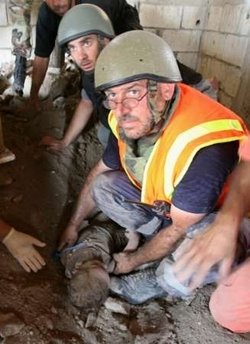
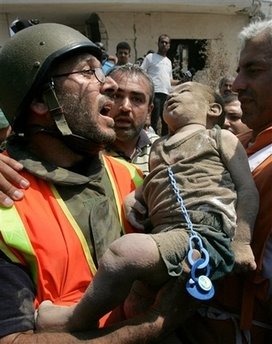
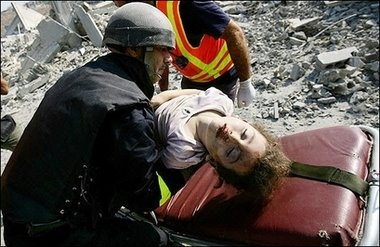
Certainly, the photographs are distressing, and indeed they are meant to be. As this piece tells us:
Until recent years, images of civilian casualties in wars often took days to appear in newspapers, but now they can be captured and transmitted around the world to newspaper Web sites, where they are posted immediately, adding to the shock value that sketchy words by reporters often cannot capture. This happened again Sunday morning in the case of the Israeli air strike on the Lebanese village of Qana that left dozens dead, reportedly at least half of them children sleeping in their beds overnight.The photos, taken by The Associated Press, Reuters, and others, showed bodies in the rubble, or being taken away; survivors digging or wailing…But the photographers, it seems, are not too fussy about how they go about "adding to the shock value". These two sequences illustrate the extent to which photographers on the scene are prepared to ensure that the "shock value" is maximised.
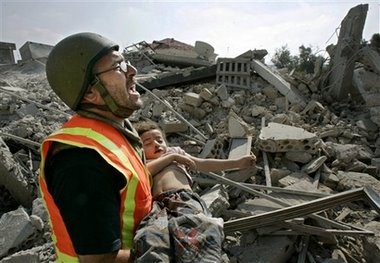
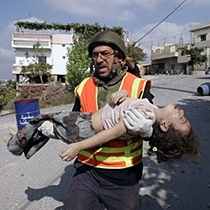
In this first of the two sequences, we see a shot by Reuters and taken by Adnan Hajj, timed at 2:21 pm. It has the caption:
Rescuers pull the body of a toddler victim of an Israeli air raid on Qana that killed more than 60 people, the majority of them women and children, in south Lebanon, July 30, 2006.Note the "rescue worker" in the foreground, complete with olive green military-style helmet and fluorescent jacket, with what appears to be a flack jacket underneath. His glasses, "designer stubble", blue tee-shirt and jeans make him quite a distinctive figure. Note also, he has a radio in his jacker pocket and he has bare hands, things which becomes relevant later.
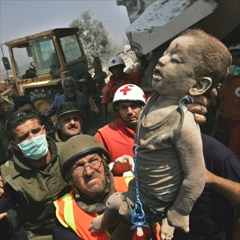
The next shot in this sequence is credited to AP's Kevin Frayer. Timed at 4.09 pm, it shows the same "rescue" worker, and has this caption:
Lebanese Red Cross and Civil Defense workers carry the body of a small child covered in dust from the rubble of his home that was hit in an Israeli missile strike in the village of Qana, east of the port city of Tyre, Lebanon, Sunday. Lebanese Red Cross officials said 56 people died in the Israeli assault on the village, including 34 children. Rescuers dug through the debris to remove dozens of bodies.This is horrific, but a scrutiny of the framing does suggest that the subject is offering the victim to the photographer.
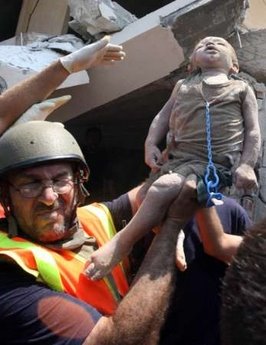
Just in case you missed it, however, we get another view, courtesy of Reuter's Adnan Hajj, with a time given of 4:30 pm - some 20 minutes after the first shot. The caption reads:
A rescuer carries the body of a toddler victim of an Israeli air raid on Qana that killed more than 60 people, the majority of them women and children, in south Lebanon, July 30, 2006.Interestingly, in this sequence, the pocket radio is missing. And, although the positioning of the child looks the same, the angle of the shot looks to be about ninety degrees from the first, but in each case, the "worker" is facing towards the camera. The shots are clearly posed.
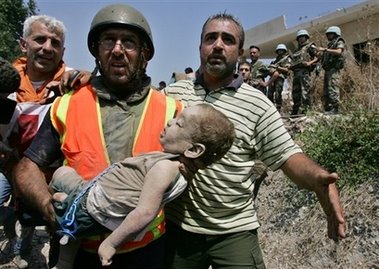
But now, timed at 12:45 pm, an hour and twenty minutes before the child's body is pictured being pulled from the ruins, we get a picture from AP's Kevin Frayer of the same child's body being paraded by our ubiquitous helmeted rescue worker.
Lebanese Red Cross and Civil Defense workers carry the body of a small child covered in dust from the rubble of his home that was hit in an Israeli missile strike in the village of Qana, east of the port city of Tyre, Lebanon, Sunday, July 30, 2006. Lebanese Red Cross officials said 56 people died in the Israeli assault on the village, including 34 children. Rescuers dug through the debris to remove dozens of bodies.
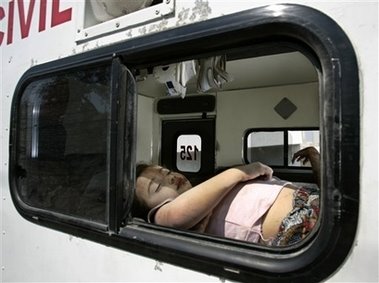
At 12.53 pm, after an interval of eight minutes, Frayer photographs the child's body again, from a different angle. The caption is the same. This time, though, our helmeted worker is showing some distress, which was absent in the previous photograph.The photographs show the characters moving down the hill, with little distance between the scenes, which suggest that they have been taken sequentially and spontaneously. But they have not. The eight minute interval has allowed a crowd to gather around "green helmet". Furthermore, "orange jacket" has switched from left to right. Note also the tee-shirted man in the centre of the picture. Then, timed at 1:01 pm, eight minutes on, we get another picture from Frayer. Once again, the caption is the same but this time the child's body is being paraded aloft by our ubiquitous helmeted rescue worker, but the tee-shirted character had moved from centre to right and is taking his turn to displaying his emotion to the camera. The UN soldier in the background has turned away, confirming a time lapse. The scene is clearly staged, as have been those preceding it.Next, we have the second of the two sequences, the first shot of which, timed at 7.21 am shows a dead girl in an ambulance. Taken by AP, the caption reads:
Among others, the body of a child recovered under the rubble of a demolished building that was struck by Israeli war plane missiles at the village of Qana near the southern Lebanon city of Tyre, is placed in an ambulance Sunday July 30.
In the next frame, we have the same girl, this time apparently being placed in the ambulance. Also taken by AP,this time by Mohammed Zaatari the caption here reads:
A Lebanese rescuer carries the body of a young girl recovered from under the rubble of a demolished building that was struck by Israeli warplane missiles at the village of Qana, near the southern city of Tyre, Lebanon, Sunday, July 30, 2006. Dozens of civilians, including many children, were killed Sunday in an Israeli airstrike that flattened houses in this southern Lebanon village - the deadliest attack in 19 days of fighting.Intriguingly, though, the dateline given is 10.25 am, three hours after she has already been photographed in the ambulance.
Also from AP's Nasser Nasser, we see the same worker, showing obvious distress, carrying the same girl. But now he is wearing his fluorescent jacket and helmet and has acquired latex gloves. He has also got his radio back. The photograph is timed at 10.44 am and the caption reads:
A civil defense worker carries the body of Lebanese child recovered from the rubble of a demolished building that was struck by an Israeli airstrike at the village of Qana near the southern Lebanon city of Tyre, Sunday, July 30, 2006. Israeli missiles struck this southern Lebanese village early Sunday, flattening houses on top of sleeping residents. The Lebanese Red Cross said the airstrike, in which at least 34 children were killed, pushed the overall Lebanese death toll to more than 500.
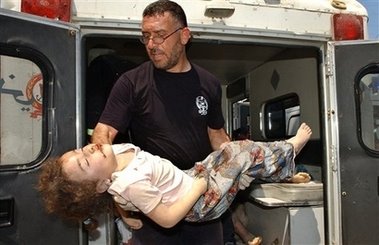
Here we are now, same "worker" and same girl, but this time it is done for the benefit of EPA, the photographer, Mohamed Messara, the worker rushing towards a uniformed Red Cross worker. This caption (without a time) reads:
A rescue worker carries the body of a Lebanese girl after an Israeli air strike on the village of Qana, east of the southern port city of Tyre, on Sunday 30 July 2006. At least 51 people were killed, many of them children, and several others wounded in the raid Sunday, witnesses and rescue workers said.
But now, for the benefit of AFP, the photgraph taken by Nicolas Asfouri, we have the same unfortunate child being handled by another worker, the original worker showing in the background, having passed the casualty on. The timing of the photograph is 7.16 pm (now apparently corrected to 6:46 am) and the caption reads:
A rescue worker puts the body of a dead girl on a gurney after Israeli air strikes on the southern Lebanese village of Qana. Israel agreed to temporarily halt air strikes in south Lebanon a day after 52 people were killed, many of them sleeping children, when Israeli warplanes bombarded the Lebanese village of Qana, triggering global outrage and warnings of retribution for alleged "war crimes".Remember, however, earlier in the sequence, the girl is being carried to the ambulance, by the other worker, sans jacket, helmet and gloves.
Finally, in this sequence, we get another shot from AP's Nasser Nasser, again without a timing but with this caption:
A civil defence worker carries a body of a young Lebanese child recovered from the rubble of a demolished building that was struck by Israeli war plane missiles at the village of Qana near the southern Lebanon city of Tyre, Sunday, July 30, 2006.Whatever else, the event in Qana was a human tragedy. But the photographs do not show it honestly. Rather, they have been staged for effect, exploiting the victims in an unwholesome manner. In so doing, they are no longer news photographs - they are propaganda. And, whoever said the camera cannot lie forgot that photographers can and do. Those lies have spread throughout the world by now and will be in this morning's newspapers, accepted as real by the millions who view them.The profession of photo-journalism thereby is sadly diminished by them, and the trust in those who took them and in those who carried them is misplaced. Truly, we are dealing with loathesome creatures.
COMMENT THREAD
permalink posted by Richard @ 12:46 AM Comments forum
postCount('115429339722244068');


The pictures that acompanied this article were graphic, a limp lifeless body of a small child being held aloft and paraded around in most of these pictures. It is difficult to believe that someone could have been so callous, but it does appear the poor child's body was used for propaganda pictures. It is also disconcerting that the same "workers"holding the body appeared in most of the pictures taken at various times, while the captions suggested in most of the photos that the child had just been removed from the rubble.

This also correlates with some articles I read about one Israeli airstrike on the building occurring at 1 am local time, but that the building didn't fall until 7 hours later. There is no indication why , if the building didn't fall at 1 am, the women and children weren't evacuated at some time in those 7 hours prior to the structure's collapse. Some have speculated that the Hezbos had stored munitions of some sort there ( a tactic they have often used), and that for an unknown reason those munitions detonated at 8 am, destroying the building. Probably we won't ever know what happened for sure, but the village was warned with leaflets prior to the start of hostilites, and this is the same village where a similar incident happened back in the early 90's, so it is odd that they did not take the warnings to leave the area prior to the start of hostilities seriously. It is an odd "coincidence" that an attack on a place in the 90's that forced Israel to cease fighting at that time, is mirrored so closely by this new attack in the same village. One villager is even quoted in another article I read as saying 'we didn't think they would do anything', which indicates that they did get the Israeli warning, but surprisingly, in light of what happened a decade ago, chose to ignore it. So who's fault is it? All I can say is some 60 village women and children who could have escaped had they heeded the warnings, paid for that folly.

Monday, July 24, 2006

Time After Time


http://www.signonsandiego.com/news/science/20060622-9999-lz1c22cause.html

Notice something wrong? Are our clocks ticking backward? The known laws of physics say there's no reason why the past, present and future must occur in that order. Backward works, too.By Scott LaFeeUNION-TRIBUNE STAFF WRITER
June 22, 2006
CRISTINA MARTINEZ BYVIK / Union-Tribune
Are we not drawn onward, we few, drawn onward to new era?
The answer would seem to be yes, if only because time always moves forward, drawing not just “we few” but everyone and everything “onward to new era.”
But what if time is like the palindrome above? What if the so-called arrow of time flies both ways, forward and back? What then? What now? What next?
People have debated the nature of time since, well, people invented it. Time is, in many ways, a fabrication of our minds, a superficial construct that helps us explain the universe, plot our course through existence and show up when we're supposed to.
“The only reason for time is so that everything doesn't happen at once,” Albert Einstein once said.
And so it goes, one thing happens, then another – a phenomenon called cause-and-effect. “It's a notion so deeply ingrained that it's hard to think about things any other way,” said Daniel Sheehan, a professor of physics at the University of San Diego.
But Sheehan does, as do other physicists who are meeting this week at USD to discuss and debate the concept of “reverse causation,” a fantastical notion that suggests effects can precede causes, and the future can influence the past, assuming the past and future actually “exist” in the first place.
(The symposium is part of the 87th annual meeting of the Pacific Division of the American Association for the Advancement of Science.)
“I don't think we've reached any kind of consensus coherent enough to be called a state of thinking,” said York Dobyns, a physicist at Princeton University who is attending the meeting. “There's a tremendous amount of disagreement about reverse causation between people who think the whole subject is just too speculative to deal with and people who have actually grappled with it, either theoretically or experimentally.”
This much, however, can be said: While reverse causation (also called backward or retro-causation) may sound like science fiction, it is firmly grounded in classical laws of physics. These laws say time is symmetrical, that it moves – or should be able to move – in all directions with equal ease.
Case in point: electromagnetism, one of the four fundamental forces of nature. (The others are gravity and strong and weak nuclear force.)
In the 19th century, Scottish mathematician and physicist James Clerk Maxwell developed equations explaining how electricity and magnetism work in tandem. It was Maxwell, in fact, who determined that electromagnetic energy, such as light and radio, traveled in waves through empty space at the speed of light.
But Maxwell's equations say nothing about the direction of time. It's irrelevant. The equations work equally well whether electromagnetic waves arrive after or before they are transmitted. In effect, writes Paul Davies, a physicist at the Australian Centre for Astrobiology and author of “About Time,” the waves “are indifferent to the distinction between past and future.”
Feeling dizzy yet?
Most physicists accept the idea of time symmetry (at least in the context of things like Maxwell's equations). The same cannot be said of reverse causation, which goes farther by suggesting the future can influence the past.

CRISTINA MARTINEZ BYVIK / Union-Tribune“The tendency is to ignore it, to say it's just a fact of nature that time moves one way,” said Michael Ibison, a physicist at the University of Texas at Austin.
If reverse causation is real, it most likely occurs at the largely theoretical and unseen level of quantum mechanics, a place where subatomic particles with names like mesons and quarks interact in ways contrary to both classical physics and common sense.
To wit: Mesons exist simultaneously as both particles and waves until they are observed. But until they are observed, they don't exist.
“Anyone who thinks they can talk about quantum theory without feeling dizzy hasn't yet understood the first word about it,” said the late, great Danish physicist Niels Bohr who, incidentally, invented much of the theory.
“People know how to calculate with quantum mechanics, but that's not to say they know what it means,” agreed Sheehan. “Quantum mechanics is like poetry. The poem is right there, for everyone to see, but it has many different interpretations.”
Sheehan offers a couple of scenarios to ponder:
First, imagine a large boulder at the top of a hill. The boulder begins rolling downhill. Now freeze the action with the boulder midway along its descent. Call this the boulder's present. At this point in time, Sheehan says the boulder is being influenced both by its past (when it was atop the hill) and by its future (when it will come to rest at the bottom of the hill). The boulder's current position midway down the hill cannot happen without the effect of both the past and the future.
“The present is always a negotiation between the past and the future,” said Sheehan.
Or think about this: You're invited to a Saturday wedding. On Friday, you go to the barber for a haircut. As you sit in the chair, the future is influencing the present. The wedding hasn't happened. It may not happen at all. And yet its possibility changes what will be the past.
The best evidence for reverse causation – perhaps the only evidence, said Sheehan – comes from parapsychology, which investigates phenomena not explained by the known laws of science, such as telepathy, clairvoyance and psychokinesis (the alleged ability to move matter with the mind).
Numbers in limbo
In 1992, a paranormal investigator named Helmut Schmidt set up a radioactive decay counter to generate sequences of random numbers, both positive and negative. The numbers were recorded, but not seen by any person. Several months later, these numbers were shown to a group of students who had been asked to use their “mind power” to skew the sequences in favor of positive numbers. Elaborate precautions were taken to prevent cheating.

According to fundamental physical laws, there should have been an equal number of positive and negative numbers. But Schmidt reported that the students saw more positive numbers; the probability of that happening was less than 1 in a 1,000.
Did the students actually influence the outcome of radioactive decay rates recorded months before? Henry Stapp, a theoretical physicist at UC Berkeley, thought so.
Stapp was one of the independent monitors of Schmidt's experiments. Two years later, he published a possible explanation for what had happened. In essence, he suggested that human consciousness had interacted with the numbers, effectively altering the past (when the numbers were recorded).
The idea, which Stapp and others have since expanded upon and promoted, is that human consciousness is an unexplained, nonlinear force of nature. Like subatomic particles in quantum mechanics, the numbers in Schmidt's experiment existed in a sort of limbo in which they were positive, negative and neither until the students saw them. At that point, human consciousness and intent (instructions to think positive) induced the numbers to assume a specific condition or quantum state.
The physics of consciousness is controversial, to say the least. And Stapp is first to say much more study and experimentation is necessary, especially by respected scientists in well-regarded scientific journals.
“You'd think people would want to either refute or confirm some of these reports,” said Stapp, “but the only people willing to test them are people who already tend to believe them. Most mainstream labs shy away for fear of sullying their reputations, as if they would be dirtying their hands by even imagining some of this is possible.”
Mind games
For Stapp, who now works at the Lawrence Livermore National Laboratories, it's not inconceivable that quantum mechanics plays some role in alleged paranormal phenomena like extrasensory perception (ESP) and remote viewing, which is the projection of one's consciousness to distant locations.
These abilities may be a consequence of nonlocality, a well-established quantum concept that says entities far-flung in distance or time are still entangled and interact via a faster-than-light, quantum mechanical connection.
Einstein called this phenomenon “spooky action at a distance.” He couldn't explain it, didn't like it and regarded it as quantum trickery.
In recent decades, nonlocality has been repeatedly observed, tested and measured in experiments. In one seminal experiment in 1982, physicist Alan Aspect at the University of Paris noted that by changing the polarity of one speeding photon (a particle of light) he could induce another photon from the same source speeding in the opposite direction to change its polarity. The interaction happened faster than light, with sufficient distance between the photons that they shouldn't have “known” what was happening to the other. And yet, inexplicably, there was some sort of link.
In contrast, paranormal phenomena like ESP and remote viewing are not as well-substantiated. Supporting evidence tends to be anecdotal. Purposeful deception and fraud are common.
In the 1970s, the U.S. Army and the CIA spent millions investigating the potential of remote viewing, but that effort apparently went for naught and funding ceased. In 1979, the Princeton Engineering Anomalies Research (PEAR) program began investigating interaction between human consciousness and the physical world. Over the years, PEAR has produced a wealth of data indicating human intent by itself, without any physical connection, can alter the behavior or results of unthinking machines. The PEAR experiments, many similar to Schmidt's 1992 random number generator test, produced only small effects, but they were observable, measurable and repeatable.
PEAR's operations, however, are now in the process of closing down, with researchers moving on to other institutions.
Dobyns, an analytical coordinator for PEAR, said he still thinks “parapsychology and related areas are useful places to look for evidence (of reverse causation).”
But he is not optimistic that many mainstream physicists will ever take up the cause. “They say it's impossible because there's no evidence and there's no evidence because it's impossible.”
But physicists like Sheehan say what we do understand about the universe fundamentally depends upon the idea that time is fluid and dynamic. “To say that it's impossible for the future to influence the past is to deny half of the predictions of the laws of physics,” he said.
Nobody's predicting a speedy or conclusive resolution to the question of reverse causation. Sheehan says it's the journey that counts, how we get from Point A to B to C – or, perhaps, from C to B to A.


I find this fascinating. The future may actually influence the past? LOL. I think it may be more likely that what we think of time, past, present, and future, may actually not be that way at all. I've read that time may be m0re like a river, where past, present and future can be compared to bends in the river, all are actually occurring at the same time, just from our perspective we can only experience one at a time. If that is the case, then the future isn't actually influencing the past, but contemporaneous events may be influencing each other, which would much easier for me to believe. Events that we view as having happened in the past, even the distant past, may be all actually be occurring in some sort of a"now' .( Sounds like one of those discussions you have with friends that seemed so wise at 2 in the morning, but in the light of day seem only too flakey LOL) Have to watch for more on this topic beofre I get too excited.

Saturday, July 22, 2006

Pacifism, a Sure Recipe for War?


Pacifists Versus Peace by Thomas Sowell July21, 2006

"One of the many failings of our educational system is that it sends out into the world people who cannot tell rhetoric from reality. They have learned no systematic way to analyze ideas, derive their implications and test those implications against hard facts.
"Peace" movements are among those who take advantage of this widespread inability to see beyond rhetoric to realities. Few people even seem interested in the actual track record of so-called "peace" movements — that is, whether such movements actually produce peace or war.
Take the Middle East. People are calling for a cease-fire in the interests of peace. But there have been more cease-fires in the Middle East than anywhere else. If cease-fires actually promoted peace, the Middle East would be the most peaceful region on the face of the earth instead of the most violent.
Was World War II ended by cease-fires or by annihilating much of Germany and Japan? Make no mistake about it, innocent civilians died in the process. Indeed, American prisoners of war died when we bombed Germany.
There is a reason why General Sherman said "war is hell" more than a century ago. But he helped end the Civil War with his devastating march through Georgia — not by cease fires or bowing to "world opinion" and there were no corrupt busybodies like the United Nations to demand replacing military force with diplomacy.
There was a time when it would have been suicidal to threaten, much less attack, a nation with much stronger military power because one of the dangers to the attacker would be the prospect of being annihilated.
"World opinion," the U.N. and "peace movements" have eliminated that deterrent. An aggressor today knows that if his aggression fails, he will still be protected from the full retaliatory power and fury of those he attacked because there will be hand-wringers demanding a cease fire, negotiations and concessions.
That has been a formula for never-ending attacks on Israel in the Middle East. The disastrous track record of that approach extends to other times and places — but who looks at track records?
Remember the Falkland Islands war, when Argentina sent troops into the Falklands to capture this little British colony in the South Atlantic?
Argentina had been claiming to be the rightful owner of those islands for more than a century. Why didn't it attack these little islands before? At no time did the British have enough troops there to defend them.
Before there were "peace" movements and the U.N., sending troops into those islands could easily have meant finding British troops or bombs in Buenos Aires. Now "world opinion" condemned the British just for sending armed forces into the South Atlantic to take back their islands.
Shamefully, our own government was one of those that opposed the British use of force. But fortunately British prime minister Margaret Thatcher ignored "world opinion" and took back the Falklands.
The most catastrophic result of "peace" movements was World War II. While Hitler was arming Germany to the teeth, "peace" movements in Britain were advocating that their own country disarm "as an example to others."
British Labor Party Members of Parliament voted consistently against military spending and British college students publicly pledged never to fight for their country. If "peace" movements brought peace, there would never have been World War II.
Not only did that war lead to tens of millions of deaths, it came dangerously close to a crushing victory for the Nazis in Europe and the Japanese empire in Asia. And we now know that the United States was on Hitler's timetable after that.
For the first two years of that war, the Western democracies lost virtually every battle, all over the world, because pre-war "peace" movements had left them with inadequate military equipment and much of it obsolete. The Nazis and the Japanese knew that. That is why they launched the war.
"Peace" movements don't bring peace but war."


An excellent analysis of pacifism if I've ever read one. Most normal people are horrified by the thought of war, and they should be, but pacifism has made war not only more inevitable but more infinitely terrible when it eventually does come. There is an episode on Star Trek ( the original series) that brings this home in a graphic mannner. Capt Kirk arrives at a planet that has supposedly been at war with a neighboring planet for 500 years. This puzzles the Capt, because although the residents say how many citizens have been killed in this war, there is no evidence of any harm to the infrastructure and the citizens seem to be living an idyllic life. Kirk is horrified to discover that the way this has been accomplished has been by "sanitizing" the horrors of war. They have turned the conduct of the war over to computers, which periodically announce virtual attacks and virtual damage. As soon as an attack occurs, computers decide how many people would have been killed, who they would be, and orders those people to report to a "disintegration chamber" where they are vaporized to a very real death. Neat, and all so very civilized. Kirk destroys the computers that run the war, causing the leaders of the planet to panic because their enemy will now start a real war. Kirk says : "Actual war is a very messy business. Very, very messy business. Death. Destruction. Disease. Horror. That's what war is all about. That's what makes it a thing to be avoided. "

Real war should be avoided because both sides want to negotiate to avoid or end its horrors. "Peace" movements, because they remove the cost for nations who want war, no matter how well intentioned they may be, just as they did after WWI serve only to make non aggressive nations less able, or even unable, to defend themselves against emboldened aggressor nations.

One side can not continue to to be forced to attempt to negotiate while the other side continues provocations with impunity. That is a recipe for the horror never ceasing since one side does not bear any serious consequences for initiating hostilities. There is no "tit for tat" here, unlike the media seem to want to portry , Israel has attempted to spare civilian lives as much as is possible, while Hezballah, and others like it, seek out civilian targets. In fact they often boast of how many Israeli civilians they have killed in this manner. The major figure Hezballah wants released is in an Israeli prison for attacking a family IN THEIR home, taking a four year old girl and the father captive, taking them both to a beach, shooting the father and killing the little girl by smashing her head against a rock. There will be no peace in the Middle East unless and until the Islamists are held to same standards of judgement as the world holds Israel to. Hopefully Israel will be able to ignore "world opinion" long enough this time to do decisively what should have been done before, defeat their enemies to the point where the cost of war will impel them to make a real and lasting peace.

Thursday, July 20, 2006

Fish with Teeth?


This fish, a native of South America and not surprisingly, related to the "piranha" was found in a lake in Texas this week.

Lends new meaning to the phrase 'Are the fish biting?'

Miserable Ingrates


http://www.washingtonpost.com/wp-dyn/content/article/2006/07/19/AR2006071900249_pf.html

http://www.rushlimbaugh.com/home/daily/site_071906/content/anchorman_2.guest.html

The recent exodus of Americans from Lebanon has shown a less than flattering portrait of my countrymen. First of all, I am surprised that there would be 25,000 Americans staying in a country that the US State Dept had, four times since November 2005, issued warnings discouraging Americans from going there. One warning said:
The U.S. Government considers the potential threat to U.S. Government personnel assigned to Beirut sufficiently serious to require them to live and work under a strict security regime. This limits, and may occasionally prevent, the movement of U.S. Embassy officials in certain areas of the country. These factors, plus limited staffing, may hinder timely assistance to Americans in Lebanon. Unofficial travel to Lebanon by U.S. Government employees and their family members requires prior approval by the Department of State. U.S. citizens who travel to Lebanon despite this Travel Warning should exercise heightened caution when traveling in parts of the southern suburbs of Beirut, portions of the Bekaa Valley and South Lebanon, and the cities of Sidon and Tripoli. Hizballah has not been disarmed, it maintains a strong presence in many of these areas, and there is the potential for action by other extremist groups in Tripoli. American air carriers are prohibited from using Beirut International Airport (BIA) due to continuing concern about airport and aircraft security arrangements. For similar reasons, the Lebanese carrier Middle East Airlines (MEA) is not permitted to operate service into the United States. Official U.S. government travelers exercise additional security measures when using Beirut International Airport. Palestinian groups hostile to both the Lebanese government and the U.S. operate largely autonomously inside refugee camps in different areas of the country. Intra-communal violence within the camps has resulted in violent incidents such as shootings and explosions. Occasionally this violence spills over into neighboring cities and towns. Travel by U.S. citizens to Palestinian camps should be avoided. Asbat al-Ansar, a terrorist group with apparent links to al-Qaeda, has targeted Lebanese, U.S. and other foreign government interests. It has been outlawed by the Lebanese government but continues to maintain a presence in the Ain al-Hilweh refugee camp. Dangers posed by landmines and unexploded ordnance throughout south Lebanon are significant and also exist in other areas where civil war fighting was intense. Travelers should be aware of posted landmine warnings and strictly avoid all areas where landmines and unexploded ordnance may be present. Tensions remain in Lebanon's southern border with the possibility of Hizballah and Palestinian militant activity at any time.

Another recent state dept bulletin says "Events in Lebanon underscore the need for caution and sound personal security precautions. Since March 2005, there have been 13 separate bombings in Lebanon, resulting in the deaths of at least 11 people and injuries to more than 100 others. " Would YOU got to a place that your government had issued this kind of warnings about? For a vacation? If you absolutely had to go for some urgent reason, would you take your family with you? So first off, I am curious as to what would prompt anyone to go to Lebanon considering these warnings. And could anyone credibly say they were caught unaware by the developments there?

There are a number of people complaining about how long it took for the American government to rescue them from a place they should never have gone to in the first place. The American government was castigated for not being as fast to have arrangements made for removing their citizens as some other countries. America has substantially more citizens in Lebanon than most other countries, and Americans would be "high profile" targets, so it would be reasonable to assume that it might take longer to set up removal plans for American citizens .

Then we have people complaining about the state of the accomodations that they are escaping on. One particularly vapid young woman ( we can be fairly certain she was vapid because she was identified as having been attending college in Lebanon despite the aforementioned warnings) complained that there was no food on board the cruise ship and complained even more that when US Marines arrived with 130 chicken sandwiches for Americans ONLY that they ( the Marines) should have brought more. Perhaps they should have brought more, but perhaps the cruise ship company should have stocked some food on the ship. Furthermore, the trip is only 100 miles, was hurriedly arranged, and under emergency evacuation conditions so perhaps the fact that these people were able to even get out of Lebanon should be given credit instead of whining about the conditions. A quick skim of the news today shows that citizens of many other countries also were whining and moaning about the service they received from their governments, instead of thanking God that they were able to escape.
These people were in Lebanon due to their own stupidity, either because they knew about the warnings and chose to ignore them ( really really dumb) or had no idea there even were any warnings ( breathtakingly uber-stupid). They should be ashamed to kvetch about the style in which they escaped Lebanon , and grateful to the government that had to rush to rescue them from their own stupidity.

Saying of the Week

"Let's not get stuck on stupid." said by General Russel Honore, Comm. La. National Guard to reporters who kept asking the same questions he'd already answered in the immediate aftermath of Hurricane Rita

I don't usually comment on my "Saying of the Week" choice but this one is outstanding and will be a classic. Who hasn't been annoyed by reporters asking the same pointless question six ways from Sunday? I'd have paid money to see the expression on the face of that reporter, LOL. And I suspect many other military men who'd been similarly bombardly by the press quietly said "Right on!" when they heard about it.

Global Warming a Naturally Occurring Event?


http://news.bbc.co.uk/1/hi/sci/tech/358953.stm
http://www.standeyo.com/NEWS/06_Earth_Changes/060719.Sun-GW.html
These articles cite increasing evidence that man made emissions from the burning of fossil fuels may play less a part in global warming than originally thought. Indeed, the actions of humans may play such a minor role as to be neglible at best. It seems that the sun periodically goes through cycles where it is more active, and since the weather on earth is influenced directly by the sun, these periods of increased solar activity result in dynamic weather here on earth. There is evidence that the earth has gone through "global warming" such as we currently seem to be having now a number of times in the past, when there obviously was no possiblity that man was the culprit, and we eventually emerged from those periods in the natural course of events. In fact, one of the most compelling pieces of evidence for "global warming" being triggered by our sun and not by man made activity is the fact that several of the planets in our solar system have also indicated evidence of dramatic warming . Obviously man made emissions have not caused any "global warming" on Mars.
This latest research highlights the folly of the "we must do something, anything NOW" approach to global warming before we have a more complete understanding of the problem. Any of the current popular "solutions" to global warming carry the possibility of significant disruptions to our society, and should not be implemented without serious consideration of the benefits vs the enormous cost to our society. Additionally, the primary way suggested to deal with global warming currently is to drastically cut fossil fuel emissions in the industrialized countries ( a scientific smoke screen for the "soak the rich" school of thought) without addressing the fact that the vast majority of these emissions are currently produced by the "Second" and "Third World" countries. Without fully investigating the actual cause of the warming prior to advocating action, we run the risk of making the cure worse than the disease.

Monday, July 17, 2006

You Are Who You Are Thanks to Your Siblings?


http://www.time.com/time/archive/preview/0,10987,1209949,00.html
I found this article from Time magazine dealing with the relationship of siblings fascinating. The author says that "traditional" research has maintained that parents, friends, spouses and innate personality have been what shapes us most. The dynamics of siblings has, until fairly recently, not even been considered. We learn negotiation,sharing, arguing, fighting, many of our most significants traits from the time spent with our siblings. We will spend more time in the company of our siblings than with anyone else, and in our most formative years. Parents may pass away, spouses may go, but siblings will always be siblings. Even how well we can relate to the opposite sex may be related to whether we had a sibling of the opposite gender to "study". I found myself nodding in agreement with a great deal of what the article said. No matter how much or how little we are alike, for better or worse, those struggles with brothers and sisters have helped shape us to become the people we are today.
And if you don't have siblings, you've probably done just fine too. In the print article in Time there was a section that is not included in the online article that briefly delved into the dynamics of children from families with one child. The most recent research puts the lie to the thought that 'only children' are self centered and so forth. The latest studies have shown that single children do quite well with mastering social interaction and develop into just as well rounded, socially adept people as those with siblings. And my own thought, sometimes they are even better, aren't they?

Thursday, July 13, 2006

Hard to Believe


http://jewishworldreview.com/0706/west071006.php3

This article by Diane West says a great deal. One of the things she mentions is that at a recent "rally" in London by Islamic militants, the 9/11 and the 7/7 murderers were praised as martyrs. She said demonstrators carried signs saying: "Behead Those Who Insult Islam," said one placard. "Slay Those Who Insult Islam," said another. "Kill Those Who Insult Islam," and (for variety) "Butcher Those Who Mock Islam". She went on to tell about a news piece about the demonstration. A van driver stopped and criticized the protestors. The interchange went :
"Listen to me, listen to me," said the policeman, shaking his finger at the van driver. "They have a right to protest. You let them do it. You say things like that you'll get them riled and I end up in (trouble). You say one more thing like that, mate, and you'll get yourself nicked (arrested) and I am not kidding you, d'you understand me?"
Van driver: "They can do whatever they want and I can't?"
Policeman: "They've got their way of doing it. The way you did it was wrong. You've got one second to get back in your van and get out of here."
Van driver: (bitter) "Freedom of speech."
This vignette wasn't law and order in action. It was desperate, craven appeasement. As the bobby put it, "You say things like that, you'll get them riled." And we mustn't get them riled. Let Choudary and his band of thugs praise mass killings, threaten more attacks and advocate murder by beheading on London streets in broad daylight — but don't get them riled. " ( D. West)


This isn't just happening in London folks, this attitude is common everywhere in the West. Once again, we pride ourselves on our "tolerance" and "diversity" towards it though. This isn't a polite difference of opinion over whether liberals are soft on criminals, or conservatives hard hearted toward the poor, over whether certain parts of society should be able to marry or not, or how to deal with illegal immigration. We are tolerating, no, encouraging, people who are praising and encouraging mass murder. And threatening to arrest those who find that talk offensive. It IS appeasement, whatever else you want to call it. No matter how many "sensitivity" courses we are forced to sit through, the fact remains that there is no give and take, we are told we must be "sensitive" to their cultural mores, but not them to the countries which have taken them in. We continue to tolerate this type of behavior, and they perceive us as weak, which encourages more of it. Just as we can't call " Fire!!" in a crowded theater, incitement to violence in this manner should not be tolerated. I am certain that if a group of marchers had been carrying signs saying "Death to Those Who Insult Christianity", " Butcher Those Who Mock Christ" and "Behead Those who Insult Christianity" and praising people who murdered in the name of Christianity, the response by authorities would be very different.

Tuesday, July 11, 2006

Political Correctness May Get Us Killed Yet

http://www.nydailynews.com/front/story/433227p-364959c.html
The news today is that a group of "jihadists" ( trans. Islamic terrrorists) has been discovered plotting to blow up the Holland Tunnel in NY City . They hoped to not only destroy the tunnel, but to also flood lower Manhattan by doing so. (Obviously they were long on terrorist thoughts and short on physics since water usually stays in the lowest part of an area, and water rushing in to fill a blown tunnel under a river isn't likely to do much flooding onto the land surrounding the river banks). Had this plot succeeded however, there could have been many people killed, the tunnel would have been unusable for some period of time, perhaps even causing a great disruption of business in the area. So far only one foreign national, a Lebanese, has been arrested for this plot, leaving me to wonder what the nationalites are of the remaining plotters. Could they be Americans? If so, we have additional evidence that we have a critical problem, how do we find Americans in our midst who want to kill their fellow Americans? How do we begin to identify the danger from within?
This was an interesting article for another reason, for what it didn't say. I read the article carefully and no where did it mention any more about these people than that they were "jihadists". I suppose this means that when we profile people looking for possible terrorists, we should ask them if they are "jihadi" or not. The one thing carefully omitted from this article is that this operation was mounted by radical Islamics, but you'd be hard pressed to discover that from reading it. Had this plot been carried out by any other religious group, I suspect it would have been headlined " Shintoists Set Plot in Motion", " Baptists Bring Big Bomb Plot to City" , "Jews Jump at Chance to Get Even" or "Catholic Nuns Strap on Bombs" , but instead this article makes no mention of the crucial fact of what is behind this action, and behind most others like it recently. Certainly not all Muslims are terrorists, but the majority of terrorism lately is being carried out by people who profess to be doing it in the name of Islam. Until we can clearly acknowledge that fact, and utilize that knowledge as a tool to attempt to discover who are plotting these things, we are in danger of of letting them succeed because we are too "politcally correct" to admit the obvious. If we are unable to even mention the common thread among the many terrorist actions that have been occurring, then we are not likely to discover how to find the enemy within.

Tuesday, May 16, 2006

Saying of the Week......

“The loveliest faces are to be seen by moonlight, when one sees half with the eye and half with the fancy” Persian proverb

Wednesday, May 10, 2006

Caring vs. Uncaring

Caring vs. uncaring-Walter E. Williams
Posted: May 10, 20061:00 a.m. Eastern
© 2006 Creators Syndicate, Inc.
George Orwell admonished, "Sometimes the first duty of intelligent men is the restatement of the obvious." That's what I want to do – talk about the obvious, starting with the question: What human motivation leads to the most wonderful things getting done?
How about the charity and selflessness we've seen from people like Mother Teresa? What about the ceaseless and laudable work of organizations like the Red Cross, Habitat for Humanity and Salvation Army? What about the charitable donations of rich Americans, to use the silly phrase, who've given something back?
While the actions of these people and their organizations are laudable, results motivated by charity and selflessness pale in comparison to other motives behind getting good things done. Let's look at it.
In December 1999, Stephen Moore and Julian L. Simon wrote an article titled "The Greatest Century That Ever Was," published by the Washington, D.C.-based Cato Institute. In it they report: Over the course of the 20th century, life expectancy increased by 30 years; annual deaths from major killer diseases such as tuberculosis, polio, typhoid, whooping cough and pneumonia fell from 700 to fewer than 50 per 100,000 of the population; agricultural workers fell from 41 to 2.5 percent of the workforce; household auto ownership rose from one to 91 percent; household electrification rose from 8 to 99 percent; controlling for inflation, household assets rose from $6 trillion to $41 trillion between 1945 and 1998. These are but a few of the wonderful things that have occurred during the 20th century.
Returning to my initial question: What human motivation accounts for the accomplishment of these and many other wonderful things? The answer should be obvious. It was not accomplished by people's concern for others, but by people's concern for themselves. In other words, it's people seeking more for themselves that has produced a better life for all Americans.
Take a minor example. I think it's wonderful that Idaho potato farmers get up early in the morning to toil in the fields, which results in Walter Williams in Pennsylvania enjoying potatoes. Does anyone think they make that sacrifice because they care about me? They might hate me, but they make sure that I enjoy potatoes because they care about and want more things for themselves.
What about all those people who've invented and marketed machines that do everything from diagnosing illnesses to controlling air flight? Were they basically motivated by a concern for others, or were they mostly concerned with their own well-being?
One of the wonderful things about free markets is that the path to greater wealth comes not from looting, plundering and enslaving one's fellow man, as it has throughout most of human history, but by serving and pleasing him. Many of the wonderful achievements of the 20th century were the result of the pursuit of profits. Unfortunately, demagoguery has led to profits becoming a dirty word. Nonprofit is seen as more righteous, particularly when people pompously stand before us and declare, "We're a nonprofit organization."
Profit is cast in a poor light because people don't understand the role of profits. Profit is a payment to entrepreneurs just as wages are payments to labor, interest to capital and rent to land. In order to earn profits in free markets, entrepreneurs must identify and satisfy human wants in a way that economizes on society's scarce resources.
Here's a little test. Which entities produce greater consumer satisfaction: for-profit enterprises such as supermarkets, computer makers and clothing stores, or nonprofit entities such as public schools, post offices and motor vehicle departments? I'm guessing you'll answer the former. Their survival depends on pleasing ordinary people, as opposed to the latter, whose survival is not so strictly tied to pleasing people.
Don't get me wrong. I'm not arguing that self-interest and the free-market system produce perfect outcomes, but they're the closest we'll come to perfection here on Earth.
Dr. Walter E. Williams is the John M. Olin Distinguished Professor of Economics at George Mason University in Fairfax, Va.


Right on! For some reason ( most probably economic ignorance) a majority of people seem to think making a profit is a "dirty word". As Dr. Williams points out, who is more interested in keeping you happy, someone who wants to make money from you, or somone motivated for 'altruistic reasons'? I think his illustration makes it perfectly clear , and one trip to the Dept. of Motor Vehicles, (or any other government agency) is enough to make you WISH they had a profit motivation in their 'business'. I have said many times that if Walmart was run like the Dept. of Motor Vehicles they'd have gone out of business long ago. But this idea of enlightened self interest being at the heart of most of our success seems not to be being taught any more. Instead of so much of the "touchy-feely mush" or 'blame America first' that passes for education today, society would be better served by some plain old fashioned economics lessons. And throw in a little of that old fashioned ' readin', writin', and 'rithmetic' and we 'd be even better off.

Thursday, May 04, 2006

Week 16 Rate the Class

If I understand this assignment correctly, we are to rate the class, good or bad, whatever we actually think.
Hmmm. Ok.......

Overall, I liked the class. I particularly liked the blogging format. I had not realized that I would enjoy blogging as much as I do. I would not have liked the more traditional 'print" form of journalism nearly so much. I think blogging plays more to my interests than regular journalism would have.

I would have a suggestion though. It might work better, and keep people from sliding behind, if assignments were given out on a particular day, and always due the next week by a particular day. Some online courses follow that format, and it makes it easier to keep track of assignments, eg, my new writing asssignments come out on Tues morning, and they are always due before 11:59 pm on the following Monday. If it isn't done by then, there is a consequence to suffer. Plus that way I always know exactly how many days until the next assignment is due without having to check. Another thing that might be worthy of consideration, in my online courses we MUST read and comment on our classmate's work. Each week. It is an incentive to finish my work in a timely mannner, because I know my classmates will be checking it out. And it is interesting to see how other people may approach an assignment very differently from the way I did.

Other than that, I liked the course. Thanks for all your work trying to turn us into aspiring journalists. : )

Bye, and good luck to all of us!

Tuesday, May 02, 2006

Week 16- Utica OD Post

http://www.uticaod.com/apps/pbcs.dll/article?AID=/20060502/NEWS/605020324/1001/news

Assembly Cancels Session in Solidarity with Immigrants

Two dozen of our illustrious state lawmakers, as if they don't already work very little ( they work fewer days but are paid much more than most other state legislators) have walked out of the state legislature "in support of the immigrant's rights demonstrations" across the country.

What? What are these Democrats thinking? What 'immigrant rights'?

Frankly, it is outrageous that lawMAKERS would be supporting lawBREAKERS!! This whole "immigrant rights" issue is a just smokescreen. It would be as if there were 12 million people who had broken any other particular law complaining that they were being labelled criminals and wanting special "rights". These ILLEGAL immigrants are CRIMINALS, and should be dealt with as such. What part of 'breaking the law makes you a criminal 'don't they understand?